
Metal roofing built for snow country
Standing seam, corrugated and Nor-Clad roofs on homes, cabins, shops and barns from Smoot to Jackson. We bend the trim ourselves in Afton, which is usually the difference between a roof that sheds snow cleanly and one that leaks at a valley in February.
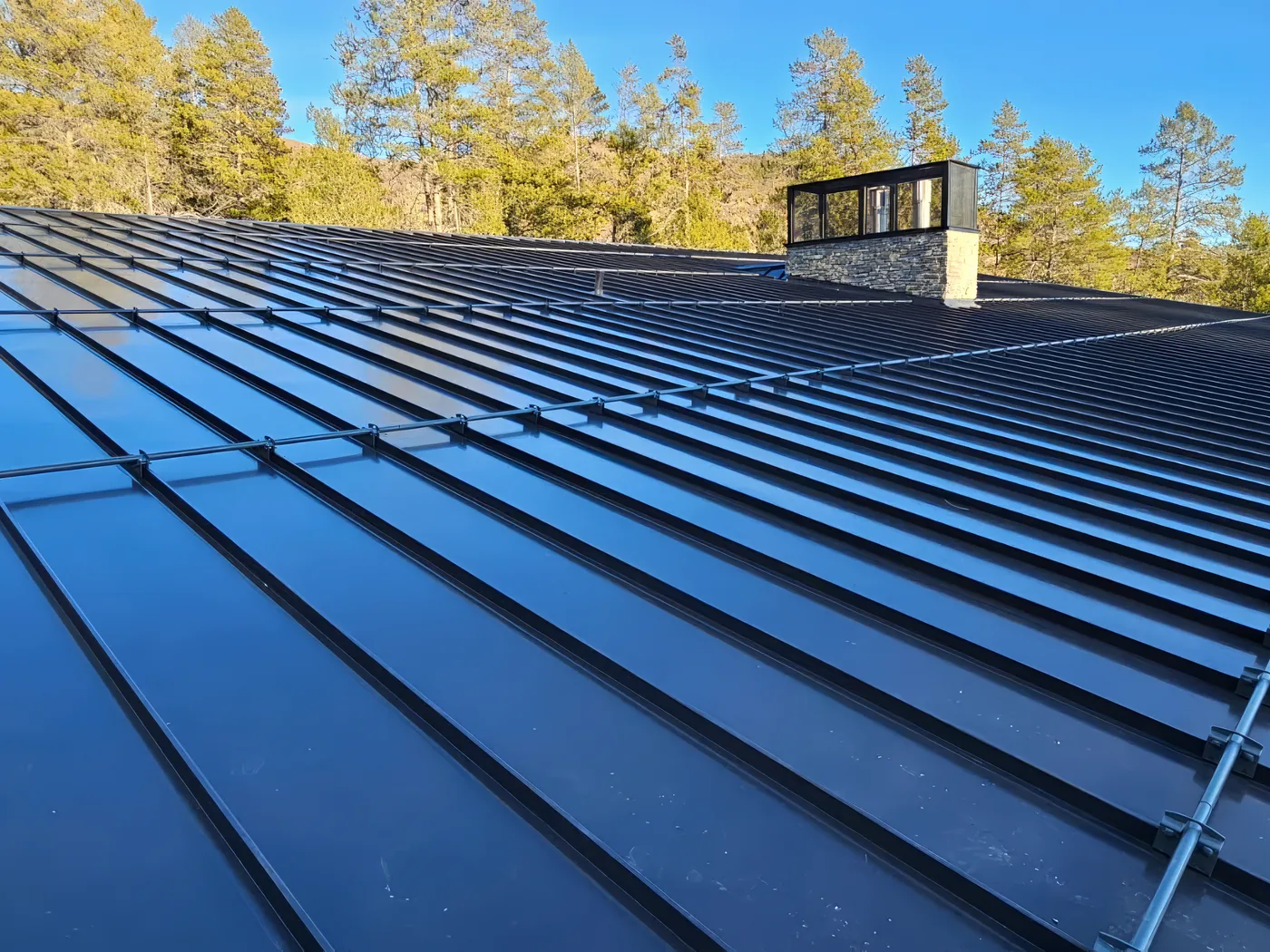
Why metal takes over here
Snow slides off a smooth metal panel instead of sitting on it. That matters in a valley that sits under snow for months, because weight is not the only problem: snow that lingers on a warm roof melts at the surface, runs down to the cold eave, and refreezes into the ice that backs water under the roofing.
Metal also handles the freeze and thaw cycle without the granule loss that ages an asphalt shingle, and it does not care about the UV at 6,000 feet the way cheaper coverings do.
How a standing seam roof is specified for this valley
Panels go down on concealed clips, so there are no exposed fasteners to back out after a few winters. The clips let the metal move as it heats and cools across a 100-degree swing, which is what keeps seams from opening.
Underneath, we run high-temperature underlayment across the deck and a self-adhered ice and water membrane along the eaves and in the valleys, where ice dams actually form. A vented ridge lets warm attic air out at the peak so the deck stays cold and the melt starts on the roof, not above it.
Trim bent in our own shop
Ridge caps, valleys, drip edge, aprons and one-off flashing are formed on our brake in Afton rather than ordered and waited for. That is why a detail that needs fixing gets fixed in the same week, and why the trim matches the panels instead of nearly matching them.
Builders and do-it-yourselfers can order trim and roofing materials straight from the shop on Highway 236.
Snow rails before we leave
Most metal roofs here need retention. Without it, the first warm day after a heavy snow drops a slab off the roof onto whatever is underneath: the entry you use every morning, the deck, the truck, the dog.
Rails and guards clamp to the seams without piercing the panel, so the roof stays watertight and its warranty stays intact. We fit them to roofs we built and to roofs we did not.
What it costs
As a rough regional planning range, standing seam runs about $11 to $17 per square foot of roof installed, with steep pitches, complex valleys and long runs pushing toward the top of that range. That range is for planning, not our price list. The only number that means anything is the one in a written bid after someone has stood on your roof.
Questions we get about this
How long does a standing seam roof last here?
Service life depends on the specific panel, coating, installation, exposure and maintenance. Ask for the panel and finish warranties separately from the workmanship warranty: a long coating warranty is not a promise that every part of the roof will last that long. Flashing, penetrations, fasteners and underlayment belong in the comparison too.
Does snow sliding off metal damage gutters or landscaping?
It can, which is what snow rails are for. Rails hold the snowpack on the roof until it melts in place, so nothing arrives at the gutter or the shrubs in one slab.
Is a metal roof loud in the rain?
Far less than people expect, because the panels sit on a deck with underlayment beneath them and insulation below that. In a finished house it does not read as louder than shingles.
Can you put metal over an existing roof?
Sometimes, but we would rather not. A reroof is the only chance to look at the deck, replace anything soft, and run the ice and water membrane where it needs to be.
How should I compare metal and asphalt over thirty years?
Compare two written bids for the same roof, including tear-off, deck repairs, underlayment, flashing and snow retention. Then consider inspections, repairs and a possible replacement during your ownership, using the actual products and warranties in those bids. A thirty-year comparison should show assumptions about replacement timing and future labor costs; it should not promise a fixed number of replacements or guaranteed savings. Our estimator is a starting range, and the crew confirms the scope and price.
Does hail damage a metal roof?
Yes. Hail can dent metal, and appearance damage is different from damage that lets water through. The result depends on the roof system and the impact; no material is hail-proof. Have the covering, seams and flashing inspected and document what is found. Dents alone do not establish that a roof needs replacement, and a contractor's inspection does not establish insurance coverage. Ask your insurer about your policy's terms and any cosmetic-damage exclusion.